Active DSP
Hypex FusionAmp: amplifier, DSP and power supply on one plate
The Dutch company Hypex is known for class D amplifiers, which you will find in many commercial active speakers as well as hi-fi amplifiers. For DIY builders it offers the FusionAmp range: ready-made modules that combine everything an active speaker needs on a single mounting plate.
What is on the plate
- An amplifier with one, two or three channels, one for each driver.
- A digital signal processor (DSP) that handles the crossover, equalisation, delay and driver protection.
- A switch-mode power supply with a direct mains inlet, so no toroidal transformer is needed.
- Inputs and controls on the plate: analogue XLR and RCA inputs, USB for programming and a mains socket with a power switch.
The plate is screwed into a cut-out in the speaker's rear panel, and the aluminium plate also acts as a heatsink. The speaker becomes an active monitor: you connect the mains and a signal from a preamplifier, DAC or streamer.
Module overview
Loudsmith knows eight modules. The name gives the power and the number of channels: FA122 means roughly 125 W and 2 channels, FA253 two channels of 250 W and a third of 100 W.
| Module | Channels | Power per channel (4 Ω) | Mounting plate |
|---|---|---|---|
| FA122 | 2 | 125 W | 120 × 315 mm |
| FA123 | 3 | 125 + 125 + 100 W | 120 × 360 mm |
| FA251 | 1 | 250 W | 120 × 280 mm |
| FA252 | 2 | 250 W | 135 × 315 mm |
| FA253 | 3 | 250 + 250 + 100 W | 135 × 360 mm |
| FA501 | 1 | 500 W | 135 × 280 mm |
| FA502 | 2 | 500 W | 150 × 381 mm |
| FA503 | 3 | 500 + 500 + 100 W | 150 × 420 mm |
The selection rule is simple. A two-way speaker needs two channels, a three-way needs three. Single-channel modules suit subwoofers. Choose the power according to the woofer and the loudness you want. A tweeter gets by with far less power, which is why the third channel of the three-channel modules has only 100 W.
Why it is worth it
The main advantages of active crossovers are covered in the article Passive or active crossover. With FusionAmp, some practical benefits come on top:
- The entire passive crossover disappears. In a three-way speaker that is typically ten to twenty parts, including expensive low-resistance coils.
- You do not need a separate amplifier. So the module's price is not an extra cost: it replaces both the amplifier and the crossover.
- The result is repeatable. The settings are a file. The second speaker sounds exactly like the first, and a year later you can load an improved version.
- Room tuning. You can store several settings as presets and switch between them.
What to watch out for
- The rear panel must be big enough. The mounting plate is 280 to 420 mm tall. A small bookshelf speaker cannot take it, and the module has to go in a stand or a separate box, with a cable running to the drivers.
- The module must not sit in the cabinet's air volume without separation. The cut-out and the electronics need an airtight enclosure; otherwise the cabinet leaks and its volume shrinks. The enclosure takes up a few litres, which have to be added on.
- The rear panel is taken. A port or passive radiator has to go on the front or the side.
- Programming. Filters are loaded over USB with the Hypex Filter Design software for Windows. Without driver measurements the settings are only an estimate, just as with a passive crossover.
How Loudsmith helps with Hypex
When you switch on active mode in the Crossover step, the app:
- picks a module according to the number of ways and the power, and shows its price,
- designs filters for each channel (Linkwitz-Riley LR2, LR4 and LR8 or Butterworth), plus delay, gain and polarity,
- adds baffle step correction and equalisation for a flat response,
- checks whether the module fits on the rear panel. If not, it tells you what height the cabinet would need, or offers placement outside the cabinet,
- adds the volume of the airtight enclosure, puts its panels in the cut list and moves the radiator to the side,
- generates FIR files to load into the amplifier (93,750 Hz) along with a list of settings, and gives step-by-step loading instructions.
In the 3D preview you will see the module on the rear panel with a photo of the real plate, so you can check how the speaker will look from behind.
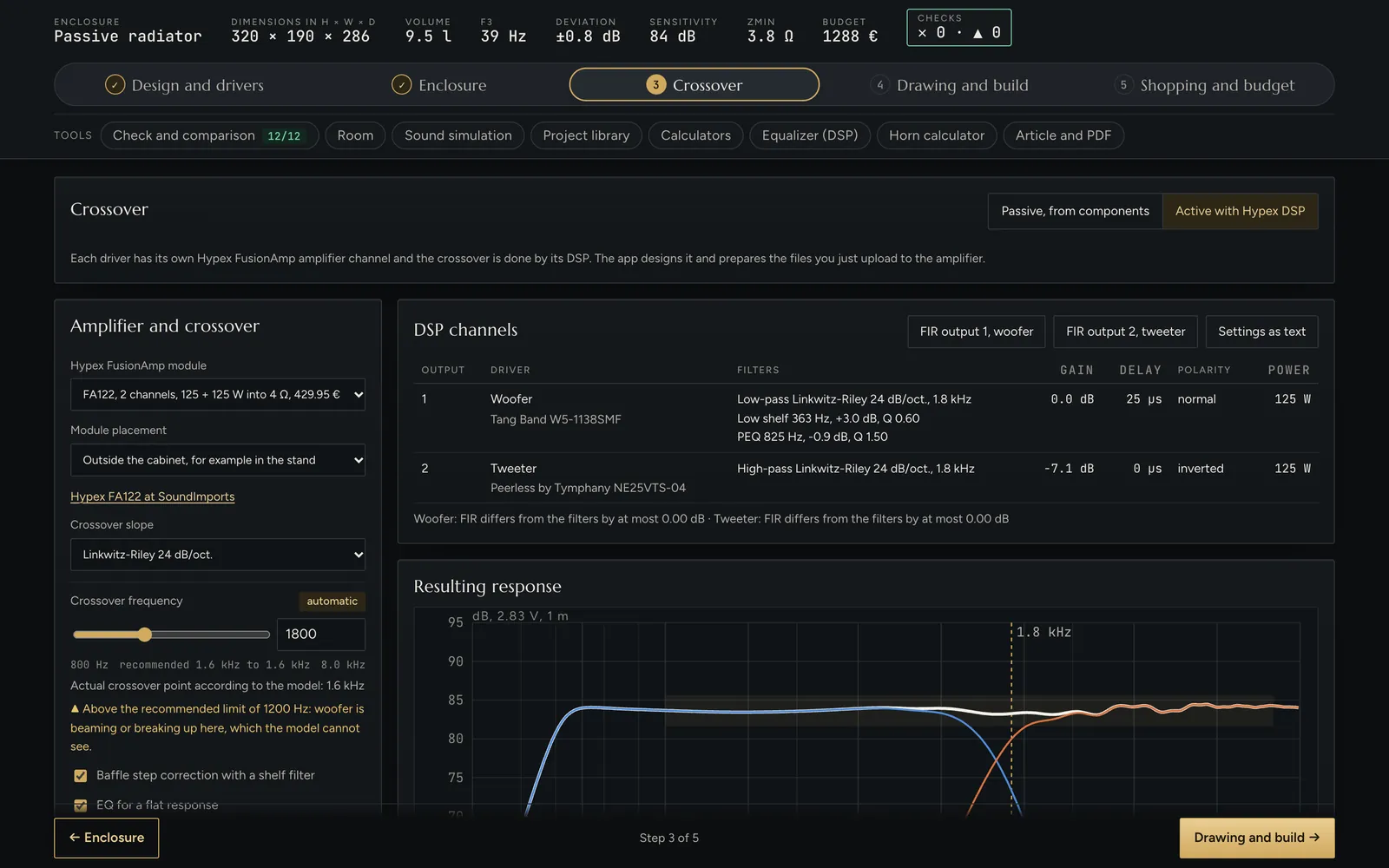
The app takes module prices from the SoundImports catalogue. If you buy the module elsewhere, you can enter your own price and the budget is recalculated.