Crossovers
Passive or active crossover: what is the difference and when is DSP worth it
Every multi-way loudspeaker needs a crossover. The woofer must not receive high frequencies, where its cone breaks up and beams the sound into a narrow lobe. The tweeter, in turn, must not receive bass, which would damage it. The crossover splits the signal between the drivers and at the same time matches their level and phase, so that they play as a single source through the transition. The question is not whether you need one, but where it goes: after the amplifier, or before it.
Passive crossover: coils, capacitors and resistors
A passive crossover sits inside the speaker between the terminals and the drivers. A single amplifier sends the full-range signal and a network of components splits it. A coil in series with the woofer passes the low frequencies, a capacitor in series with the tweeter passes the highs. Resistive dividers bring the more sensitive driver down to the level of the others, and further networks adjust the impedance or remove a resonance peak.
The advantages are obvious: the speaker needs just one cable and one amplifier, needs no power supply and lasts for decades. That is why it is still the most common solution.
Passive crossovers also have limitations worth knowing about:
- The crossover works with the driver's impedance. That impedance changes with frequency, so “textbook” values almost never fit. The crossover has to be designed for the real impedance of the specific driver in its cabinet.
- Losses. The coil in front of the woofer has resistance. It reduces both the amplifier's control over the driver (damping) and the sensitivity, and at large values the coil is expensive and heavy.
- Tolerances and heat. Components have tolerances, and at high power the driver's voice coil heats up. Its resistance rises and the crossover frequency shifts slightly.
- Every change means soldering. Fine-tuning after measurement is slow, and every iteration costs components.
Active crossover: split first, amplify second
With an active crossover the signal is split before the amplifier, at line level. Each driver has its own amplifier channel connected directly, with no components between it and the driver. The splitting is done by an analogue circuit or, more often these days, by a digital signal processor (DSP).
What this changes:
- Precise filters. A 24 or 48 dB per octave slope is just a setting in DSP. The filter does not depend on the driver's impedance and does not age.
- Time alignment. The acoustic centres of the drivers are not in one plane. DSP adds a delay of a few microseconds and the drivers line up without a sloped front baffle.
- Equalisation. The bass loss below the baffle transition (baffle step), a driver resonance or ripple in the response can be corrected with a few parametric filters. Done passively, that would mean more coils and more losses.
- Better damping and more power. The amplifier “holds” the driver directly. Power is split between channels, so even a loud bass note cannot overload the tweeter's channel.
- Changes without soldering. You load new settings into the processor in a few seconds. You can keep several presets, for example for placement near a wall and out in the room.
So why isn't everything active?
An active speaker needs a power supply, an amplifier and a processor for every set of drivers. That used to be expensive and complicated, with several amplifiers and an external rack-mounted processor. Programming was another hurdle: without measurements and experience, DSP can be set up just as badly as a passive crossover.
That changed with modules that combine the amplifier, DSP and power supply on a single plate mounted in the speaker's rear panel. A typical example is the Hypex FusionAmp. The active speaker then connects like an ordinary active studio monitor: a mains cable and a signal from a preamplifier or player.
Comparison at a glance
| Passive | Active with DSP | |
|---|---|---|
| Amplifier | one per speaker, external | a channel per driver, built in |
| Filters | depend on the driver's impedance | precise, independent of the load |
| Time alignment | mechanical only | delay in DSP |
| Equalisation | extra components with losses | lossless, as much as you like |
| Fine-tuning | soldering and new components | new settings on the computer |
| Power supply | not needed | mains lead in every speaker |
| Cost | lower for simple crossovers | higher for the module, but no components or amplifier needed |
When each solution makes sense
A passive crossover makes sense if you already have a good amplifier, are building a classic two-way bookshelf speaker or want a speaker with no electronics. A simple second-order crossover with a few parts is cheap and, with good drivers, sounds excellent.
Active crossovers pay off in three-way speakers, where a passive crossover would have dozens of parts, with large woofers that need large coils, and with open baffles and dipoles that need strong bass equalisation. They also help when you want to tune the speaker to the room. For a three-way speaker, the active solution often costs about the same as a quality passive crossover plus a separate amplifier.
How Loudsmith handles it
In the Crossover step you switch between a passive design built from components and active crossover with a Hypex module. For a passive crossover the app picks values from the shop's range, including coil resistance, and shows the schematic and the resulting response. For an active one it designs the filters, delay, gain and polarity for each channel and generates FIR files to load into the amplifier. Both options use the same enclosure model, so you can compare their results directly.
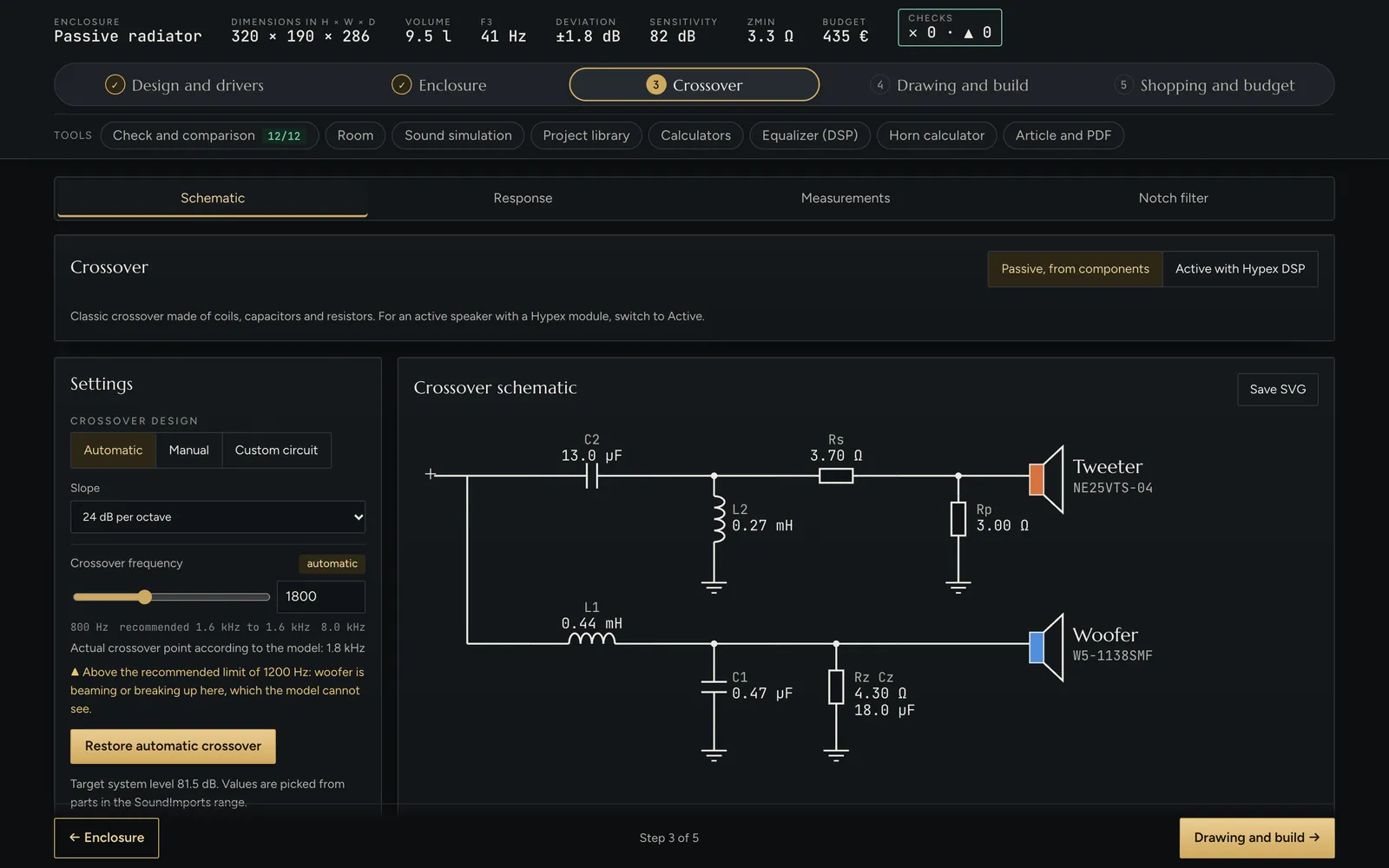
The model is an estimate. With either a passive or an active crossover you get the best result by measuring the drivers in the finished cabinet and loading the FRD and ZMA measurements into the app.