Room acoustics
The room plays along: modes, reflections, reverberation and speaker placement
The same loudspeaker sounds completely different in two rooms. Below roughly 200 Hz the room can change the bass level by 10 to 20 dB, depending on where the speaker stands and where you sit. That is more than a badly designed crossover can ruin. This is why Loudsmith has a dedicated Room tool. Here we explain what it calculates and why.
What you enter
- Room dimensions: width (the wall behind the speakers), length and ceiling height.
- Reverberation time T60, the time it takes for sound to decay by 60 dB after it stops. A typical living room has 0.4 to 0.6 s; a bare room with a hard floor can exceed 0.8 s.
- Placement: distance from the wall behind the speaker and from the side wall, stand height, the listener's distance from the rear wall and ear height.
- Optionally a listening zone, if you only listen in part of a large room, a range for the stereo base width and a fixed seating position.
The app takes the cabinet dimensions and driver heights from your design. It also knows whether it is a conventional box or a dipole (open baffle), which behaves differently in a room.
Two regions: modes and the diffuse field
The acoustics of small rooms divide into two regions, separated by the Schroeder frequency:
fS = 2000 · √(T60 / V)
where V is the room volume in m³. For a 4 × 6 × 2.6 m room with a reverberation time of 0.45 s it comes to roughly 170 Hz.
Below this frequency the room is a resonator. Standing waves, known as modes, form between parallel walls. The strongest are the axial modes between two walls:
f = n · c / (2 · L), for n = 1, 2, 3…
For a length of 6 m that gives 29, 57, 86 Hz and so on. Besides axial modes there are also tangential and oblique modes. Each mode has maxima at some positions and nulls elsewhere. The bass can therefore double in one spot and almost disappear half a metre away. Loudsmith sums the contributions of all modes up to roughly twice the Schroeder frequency (at least 250 Hz). For the speaker it uses the position of the woofer, and for the seat the position of the head.
Above the Schroeder frequency there are so many modes that they merge into an even reverberant field. There the app works with the speaker's direct sound and a diffuse reverberant field, following Siegfried Linkwitz's approach.
Critical distance
Close to the speaker, direct sound dominates; further away, reflected sound does. The boundary is the critical distance (reverberation radius):
rc = 0.1 · √(G · V / (π · T60))
G is the directivity of the source: 1 for a conventional box, 3 for a dipole. A dipole radiates less to the sides, so its critical distance is about 1.7 times greater. If you sit further away than three times rc, you hear mainly the room and the stereo image dissolves.
Reflections that cause dips
Reflected sound reaches the ear with a delay. At the frequency where it is delayed by half a wavelength, it cancels against the direct sound and a dip appears. The app calculates the three most important reflections from the path-length difference between direct and reflected sound:
- The wall behind the speaker. A dip at f = c / (4 · d), where d is the distance of the driver from the wall. At 1 m that is 86 Hz. Close to the wall the dip moves higher, above the woofer's band, which is why placing the speaker right against the wall also helps.
- The side wall. A reflection shorter than 3 ms merges with the direct sound and blurs the image. From 6 ms on it is harmless.
- The floor. The floor reflection between the speaker and the listener. If the dip falls in the midrange (120 to 600 Hz), an equaliser cannot fix it. A different woofer height or a rug helps.
Nine placement checks
The calculation produces a table of checks with targets and advice:
| Check | Target |
|---|---|
| Room effect on bass (25 to 250 Hz) | spread within ±4 dB |
| Stereo triangle | 60° angle, 40 to 90° acceptable |
| Distance from the wall behind the speaker | at least 1 m (dipole 1.2 m), reflection after 6 ms |
| Distance from the side wall | at least 1 m or reflection after 6 ms |
| Floor reflection | dip outside 120 to 600 Hz |
| Room reverberation | 400 to 600 ms |
| Listener and critical distance | at most 3 × rc |
| Tweeter height | at ear height, within ±12 cm |
| Room size | at least 15 m² (dipole 22 m²) |
Finding the best placement
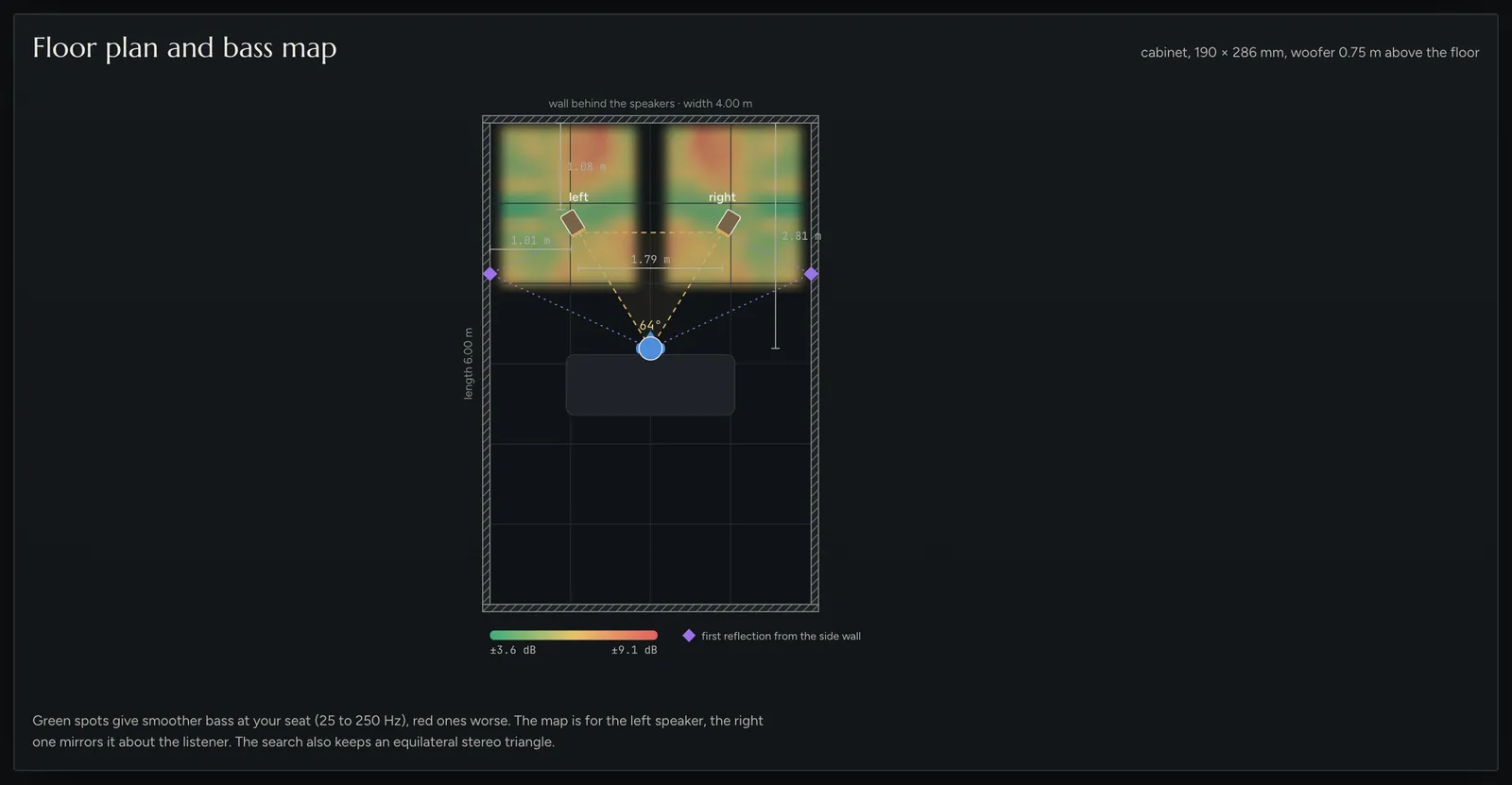
The Find the best placement button runs through a grid of speaker and seating positions. It keeps the speakers symmetrical and looks for the combination with the flattest bass at the listening position and a stereo triangle angle as close as possible to 60°. If the seat is fixed, it moves only the speakers. If a listening zone is set, it stays within it.
You see the result on a floor plan with a bass map: green areas give flatter bass, red ones worse. The floor plan also marks the first-reflection points on the side walls, where absorption or a diffuser is worth placing. A graph compares the in-room bass with free space, and a table lists the axial modes up to 200 Hz.
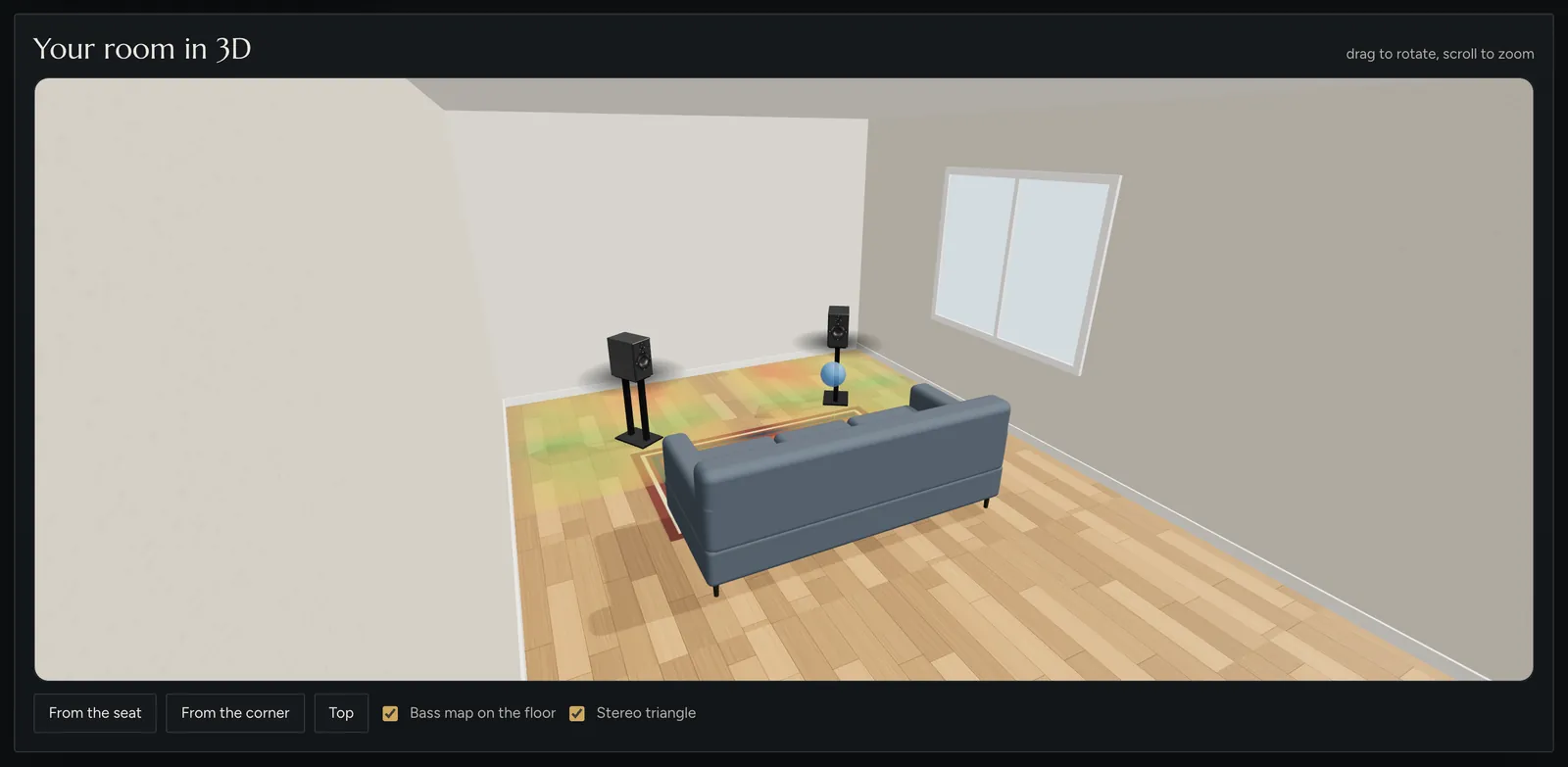
In the 3D view your speaker stands in a furnished room with the bass map on the floor and the stereo triangle. You can look from the listening seat, from a corner or from above.
Practical tips
- Do not sit in the middle of the room. Halfway along the length lies the null of the first axial mode, and the bass is missing there. Sitting at around 38 % of the length from the wall usually works better.
- Keep both the speakers and the seat as far from the corners as possible. A corner excites all modes at once.
- If the speaker has to stand near a wall, choose the “near a wall” placement in the Design step. The model then assumes less bass loss and the crossover uses less baffle step correction.
- A rug between the speakers and the listener, curtains and a full bookcase shorten the reverberation and reduce the floor reflection.
The model assumes a rectangular room with rigid walls in a steady state. Real walls let some bass through, furniture absorbs and an open door changes the modes. The result is reliable for comparing placements; the exact numbers can only be confirmed by a microphone measurement at the listening position.