Design process
How experienced designers create loudspeakers
A great-sounding loudspeaker is the product of a process, not chance. Experienced designers differ in taste and in their favourite solutions, but their process is strikingly similar. Let's go through it step by step, and look at what some of the designers whose builds you will find in the Loudsmith project library are known for.
1. The brief before the drivers
A beginner starts with a favourite driver. An experienced designer starts with questions: how big can the speaker be, where will it stand, how loud and how deep does it need to play. Between cabinet size, bass extension and sensitivity there is a trade-off known as Hoffman's Iron Law: of the three, you can only ever have two. The brief therefore matters more than the driver brand.
In Loudsmith: a six-question design guide and the brief in the first step, from which the app derives the targets and the driver selection.
2. Choosing drivers by data, not by price
A woofer is chosen by its Thiele-Small parameters: resonance Fs, total Q Qts, equivalent volume Vas and excursion Xmax. They determine which cabinet it suits and how much bass it can deliver. For a tweeter, what matters is how low it can be crossed; for a woofer, where it starts to beam and where its cone breaks up. Good pairs have an overlap in which both drivers play cleanly and with similar directivity.
In Loudsmith: a catalogue of 1,604 drivers with complete parameters, woofers ranked by cabinet simulation, and tweeters ranked by how well they match the chosen woofer.
3. Cabinet simulation
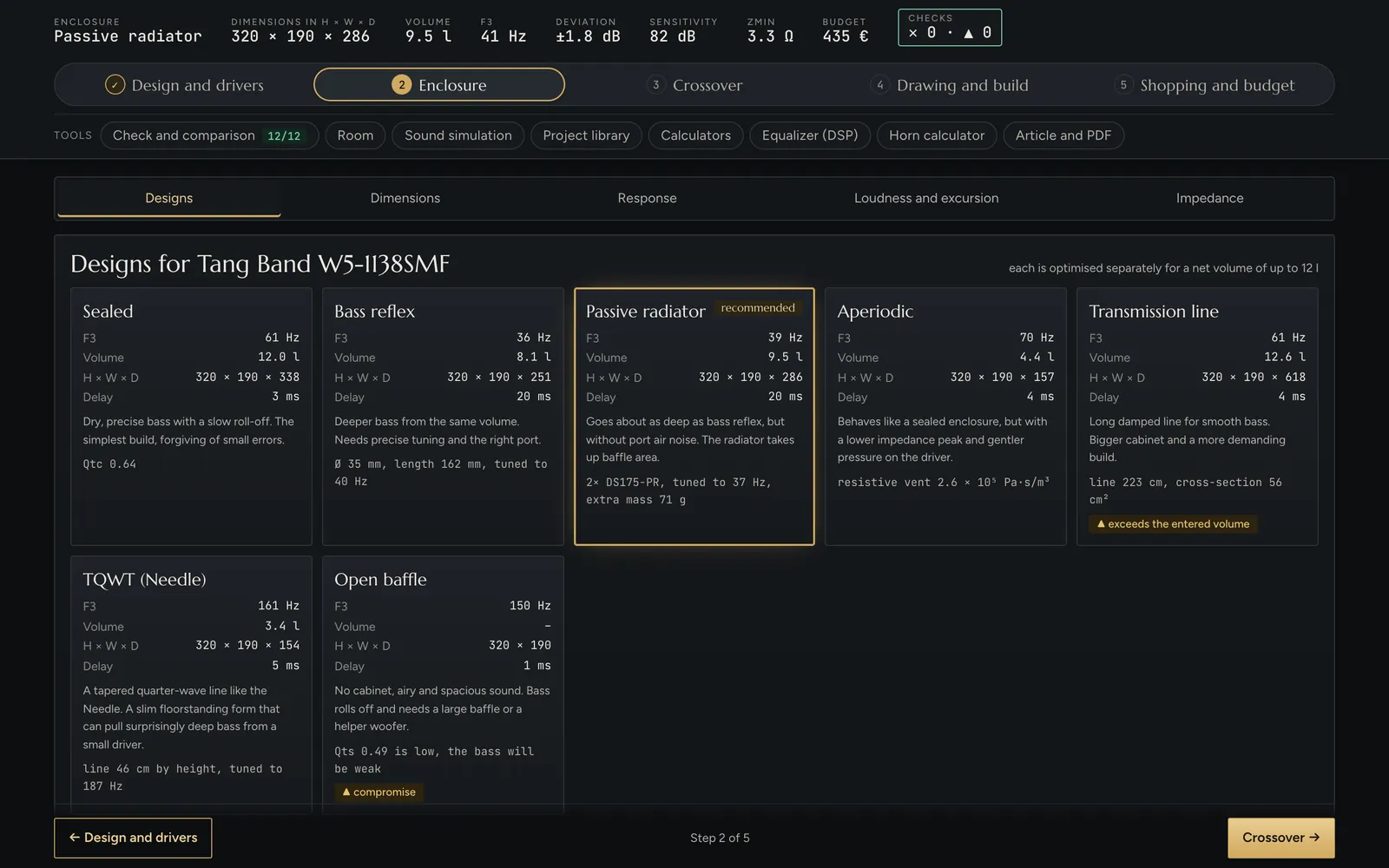
Before the first panel is cut comes the simulation: sealed or bass reflex, what volume and what port tuning. Besides the frequency response, cone excursion, port air speed and group delay are also watched. A speaker that plays deep on the graph but hits Xmax or chuffs through the port at normal listening levels is a bad design.
In Loudsmith: seven enclosure types at once, with a comparison and a recommendation.
4. Measure, measure, measure
This is where amateurs and experienced designers part ways the most. Manufacturer data is measured on an infinite baffle. A real driver in a real cabinet shows ripple from edge diffraction, cabinet resonances and unit-to-unit variation. That is why drivers are measured in the finished cabinet with a microphone (frequency response, an FRD file) and an impedance jig (a ZMA file). Only on this data is the crossover designed.
In Loudsmith: FRD and ZMA files for each driver replace the model and the crossover is recalculated for them. Without measurements the app estimates diffraction from the baffle dimensions.
5. A crossover for the real load
The goal is not “a 2nd-order filter at 2 kHz” but an acoustic result: the driver's output, including its own response, should follow a target curve, for example a 4th-order Linkwitz-Riley. The electrical filter is only the means. That is why component values are optimised against measurements, and with a passive crossover the coil losses are taken into account too.
In Loudsmith: automatic design to an acoustic target, a manual mode, a free-form network editor and active crossover with DSP.
6. Listening and iteration
The last tenths of a decibel in tweeter level or the shape of the transition are tuned by ear in the room where the speaker will play. Experienced designers make several versions of the crossover and compare them. It follows that even the best model cannot replace measurement and listening.
What some designers are known for
John Krutke – Zaph Audio
On the Zaph Audio website he published dozens of designs and comparative driver measurements. His designs, such as the ZD5 or the ZA-SR71, are built on thorough measurement and passive crossovers designed on measured data. For every design he published graphs showing how the result was verified. For many DIY builders it remains the model of what a well-documented project should look like.
Siegfried Linkwitz – Linkwitz Lab
Linkwitz co-created the Linkwitz-Riley filter used by most crossovers today. In his own designs, such as ORION and PLUTO, he championed active crossovers with equalisation and open baffles (dipoles), which excite the room less. He wrote extensively about how the room changes our perception of sound, and recommended an equilateral stereo triangle and ample distance from the walls. Loudsmith's room model is also built on his findings.
Martin J. King – quarter-wave.com
King worked on mathematical models of quarter-wave designs: transmission lines, TQWT and ML-TL. His calculations showed that these “mysterious” enclosures can be simulated accurately, provided the distribution of damping material and the driver's position on the line are taken into account.
Needle – Acoustic Design Magazin
The Needle is a narrow, slim tower speaker with a full-range driver in a TQWT enclosure. It shows that a simple design without a crossover can sound surprisingly good when the driver and the line are well matched. Loudsmith uses it as a reference both for comparison and for listening.
Key takeaways
- The brief first, the drivers second.
- Simulate the cabinet including excursion and port air speed, not just the response.
- Design the crossover to an acoustic target, ideally on measurements from the finished cabinet.
- Take into account the room where the speaker will play.
- Start with a proven design and learn from it. In the project library you open one in a single click.