Build diary
Build diary: a Tang Band W5-1138SMF and Peerless NE25VTS-04 bookshelf speaker
This is my next speaker and a real-life test of Loudsmith at the same time: a small two-way bookshelf speaker designed in the app from the choice of drivers to the cut list. I am getting ready to build it now. Once it is finished, I will add measurements and a comparison with the calculation here, so you can see how well the model holds up.
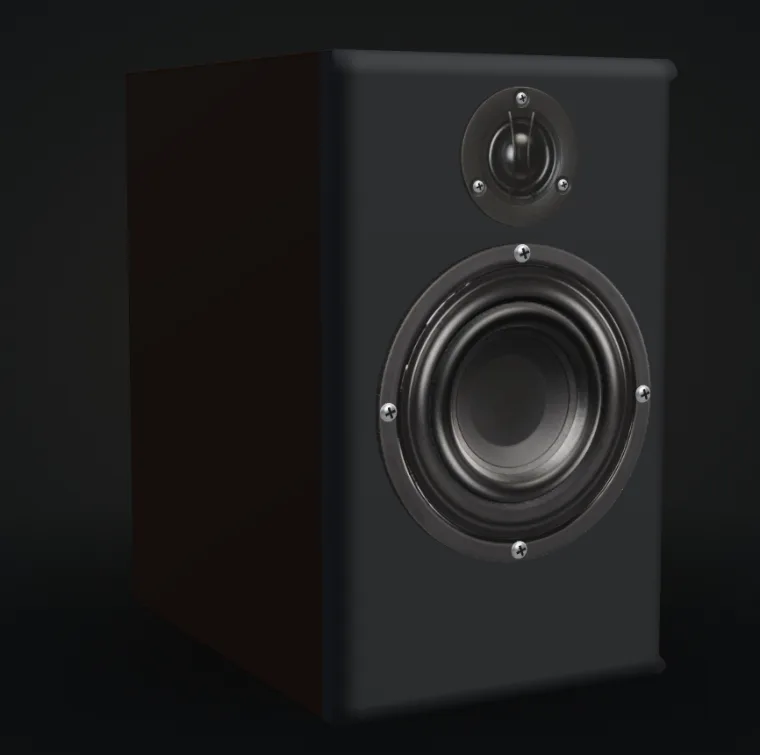
The design at a glance
- Woofer: Tang Band W5-1138SMF, 5.25", paper cone, 4 Ω
- Tweeter: Peerless by Tymphany NE25VTS-04, 1" soft dome
- Cabinet: 9.5 l with an SB Acoustics SB15SFCR-00 passive radiator at the back
- Size: 190 × 320 × 286 mm (w × h × d)
- Tuning: 43 Hz, 3 dB down at 41 Hz
- Crossover: 1,800 Hz, acoustic Linkwitz-Riley 24 dB/oct target
Why these drivers
The Tang Band W5-1138SMF is unusual for a 13 cm woofer: its linear excursion is 9.25 mm, which is a lot for a driver this size. Its resonance is low, at 45 Hz, with a Qts of 0.49. The price is a lower sensitivity of about 85 dB, but in a small box it gives bass you would not expect from its size.
The Peerless NE25VTS-04 is an inexpensive but honest soft dome with a 730 Hz resonance and 91 dB sensitivity. It is 6 dB more sensitive than the woofer, so the crossover includes an L-pad. For a crossover around 1,800 Hz it is a safe choice: the power reserve is 3.2 W at 93 dB against the 15 W the tweeter can take.
The cabinet: a radiator instead of a port
Loudsmith compared all seven cabinet types. At 9.5 litres a bass reflex would need two 25 mm ports, which could chuff at higher levels. A passive radiator does the same job without air rushing through a tube. The SB15SFCR-00 displaces 196 cm³, more than twice the woofer's 87 cm³, so it will not be the limit.
- 22 mm MDF front baffle with 12 mm rounded edges, the other panels 18 mm.
- 9.5 l net, 10.8 l gross, one 30 × 30 mm brace between the side panels.
- Radiator and terminals on the back panel, polyester wadding for damping.
TotalWoofer with crossoverTweeter with crossover
The crossover
The crossover ended up at 1,800 Hz. At this frequency the woofer does not beam yet (that would start around 2 kHz) and the tweeter is well above its resonance. Every part comes from the shop's regular range, coil resistance included.
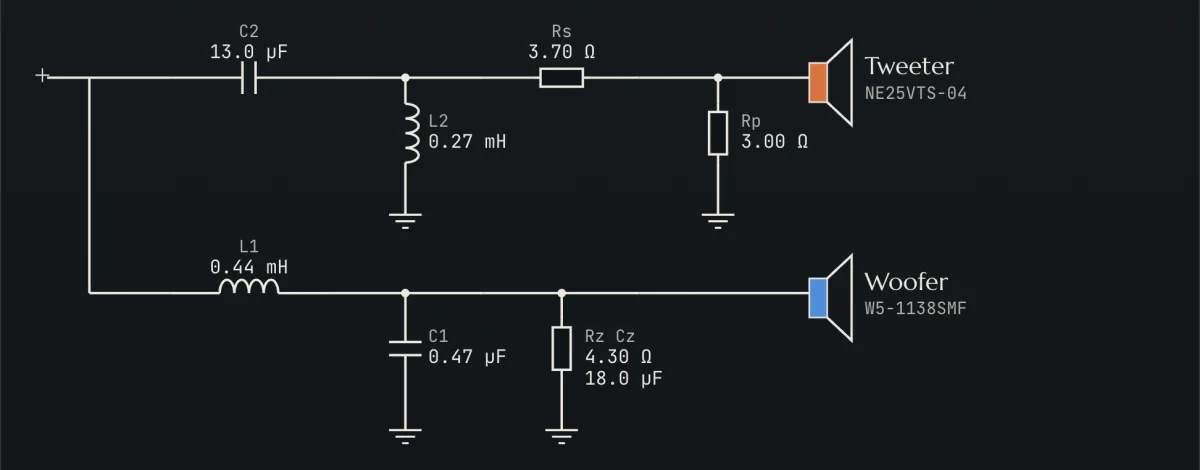
| Branch | Parts | Role |
|---|---|---|
| Woofer | L1 0.44 mH (0.31 Ω), C1 0.47 µF | low-pass |
| Woofer | Rz 4.3 Ω + Cz 18 µF | Zobel, flattens the woofer's rising impedance |
| Tweeter | C2 13 µF, L2 0.267 mH | high-pass |
| Tweeter | Rs 3.7 Ω, Rp 3.0 Ω | L-pad, brings the tweeter down to the woofer's level |
What the checks say
All twelve automatic checks pass. The key figures:
- Bass: −3 dB at 41 Hz, −6 dB at 37 Hz.
- Loudness: up to 94 dB at 62 Hz (limited by the woofer's power rating), 93 dB at 150 Hz.
- Bass delay: 19 ms, just under the 20 ms limit.
- Tweeter and the baffle edges: centred on the baffle, the edge echoes add up around 7 kHz. The model predicts a slight ripple there, and the rounded edges soften it.
Two things the model cannot check: cone breakup and off-axis radiation. Only a measurement will show those.
Where it will stand
For my 4 × 6 m room the room planner suggests the speakers 1.08 m from the back wall and 1.01 m from the side walls, with the seat 2.81 m from the front wall. With the radiator at the back, the extra distance from the wall helps.
Budget
| Item (pair) | Price |
|---|---|
| Drivers: 2 woofers, 2 tweeters, 2 passive radiators | €255.70 |
| Crossover parts | €70.64 |
| Terminals and damping | €27.80 |
| Total without the panels | €354.14 |
Prices are from the SoundImports catalogue on the day of the design. MDF panels and glue come on top.
Next: building and measuring
Once it is built, I will measure it with a UMIK-1 measurement microphone using the speaker measurement page: far field for the mid and treble, near field at the cone and the radiator for the bass. I will load the measured FRD into the app and fine-tune the crossover with it. The results and the comparison with the calculation will be added to this article.
Want to look at the design or build it yourself? Download the project file and open it in the app with Import project.
Free tools: Room planner · Speaker measurement