Build diary
Needle: the legendary slim full-range column, calculated and measured
The Needle is one of the best-known DIY full-range speakers: a slim column with a single 10 cm driver that plays with a surprisingly big sound. I have built one, and it is in Loudsmith as a ready-made template. This article compares what the original design says, what Loudsmith calculates and what a measurement shows.
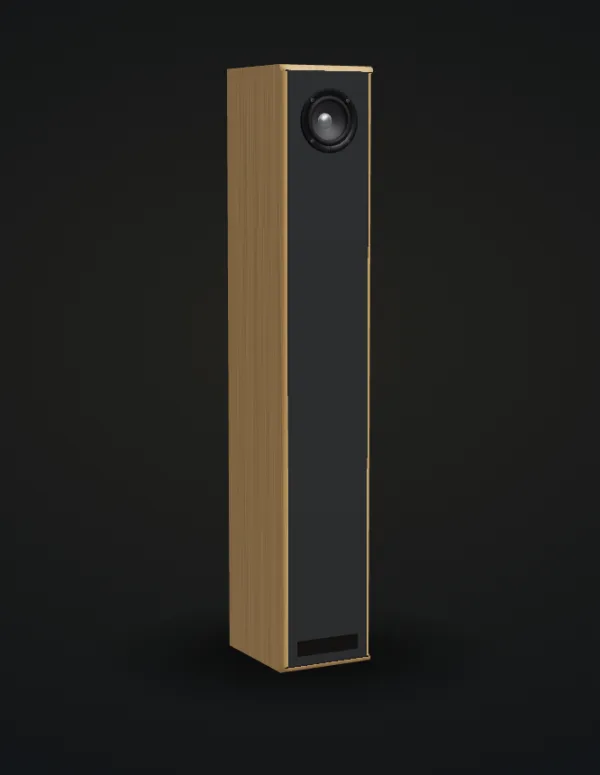
The Needle at a glance
- Driver: Dayton Audio RS100-4, 4" full-range, 4 Ω
- Cabinet: TQWT, a line with a growing cross-section
- Size: 160 × 950 × 196 mm (w × h × d)
- Line: 1,746 mm long, 46 → 130 cm²
- Outlet: 25 × 110 mm at the front, bottom
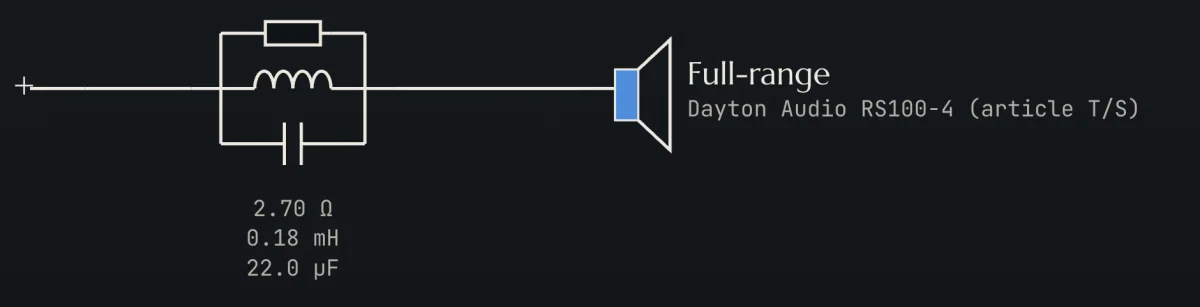
- Correction: 2.7 Ω ∥ 0.18 mH ∥ 22 µF in series with the driver
Where the Needle comes from
The original design was drawn by a builder known as Cyburgs and shared on the Hifi-Forum as a simple sketch. The Needle was not built around one particular driver, and it quickly spread among home builders. Udo Wohlgemuth of Acoustic Design Magazin asked the author for permission and reworked it for the Dayton RS100. The updated build guide was published in July 2017 as "Needle aufgewärmt".
Why the Dayton: small full-range drivers usually resonate well above 100 Hz. The RS100 does so around 75 Hz, almost 40 Hz lower than the drivers in the original Needle. The author chose the 4-ohm version because, on the same amplifier, it plays about 3 dB louder than the 8-ohm one.
How a TQWT line works
A TQWT, a tapered quarter-wave tube, is related to a transmission line but follows different rules:
- At the closed end its cross-section is about the size of the cone, and it widens two to three times towards the outlet.
- Its length is a quarter of the wavelength of the tuning frequency.
- The driver sits a third to a half of the length from the closed end.
- The outlet is smaller, about half the cone area.
The idea goes back to Paul Voigt in 1934, which is why it is also called a Voigt pipe. In the Needle the line is folded in the middle, with a slanted divider from 42 mm behind the front panel at the bottom to 86 mm at the top. The sides, top and bottom are 25 mm MDF, the front and back panels 12 mm. The damping is a single 10 cm wide strip of polyester wadding laid into the line unfolded.
The correction network
The RS100-4 has a slightly raised level between 400 and 5,000 Hz, which the narrow baffle makes even stronger. The correction network, a 2.7 Ω resistor, a 0.18 mH coil and a 22 µF capacitor in parallel, all in series with the driver, tames this hump around 2.5 kHz. The values come from the original kit. The author deliberately left the peak at 18 kHz alone.
What Loudsmith calculates
The model shows a typical small full-ranger: the bass falls gently, 6 dB down around 65 Hz, and the line carries it lower still, only weaker. At 50 Hz it reaches about 80 dB at most before it runs out of its 4 mm excursion. At 150 Hz it manages 96 dB. That is plenty for close listening in a living room, not for a party.
Impedance is the best test of a line model, because the whole cabinet shapes it. The original article shows the measured impedance of the finished Needle, and the comparison with the calculation comes out like this:
| Frequency | Measured (ADW) | Loudsmith |
|---|---|---|
| 80 Hz | 12.2 Ω | 12.0 Ω |
| 500 Hz | 3.9 Ω | 3.7 Ω |
| 2.5 kHz | 6.5 Ω | 6.6 Ω |
| 20 kHz | 9.9 Ω | 10.0 Ω |
Agreement within 0.2 Ω means the model gets both the line and the correction right. This comparison is part of Loudsmith's automated tests.
Measuring the finished speaker
I will measure my Needle with a UMIK-1 measurement microphone using the speaker measurement page: far field for the mid and treble, near field at the cone and at the line outlet for the bass. The measured curve will go here next to the calculation, so you can see where the model matches and where it does not.
The measurement is on its way. I will update the article as soon as I have it.
Build one yourself
The Needle is a ready-made template in the app: in the designer, pick Needle from "Start from a template". You get the dimensions, a drawing with the divider, the correction and the shopping list. For the author's plans and the kit, see the original Acoustic Design Magazin article.
Free tools: Room planner · Speaker measurement